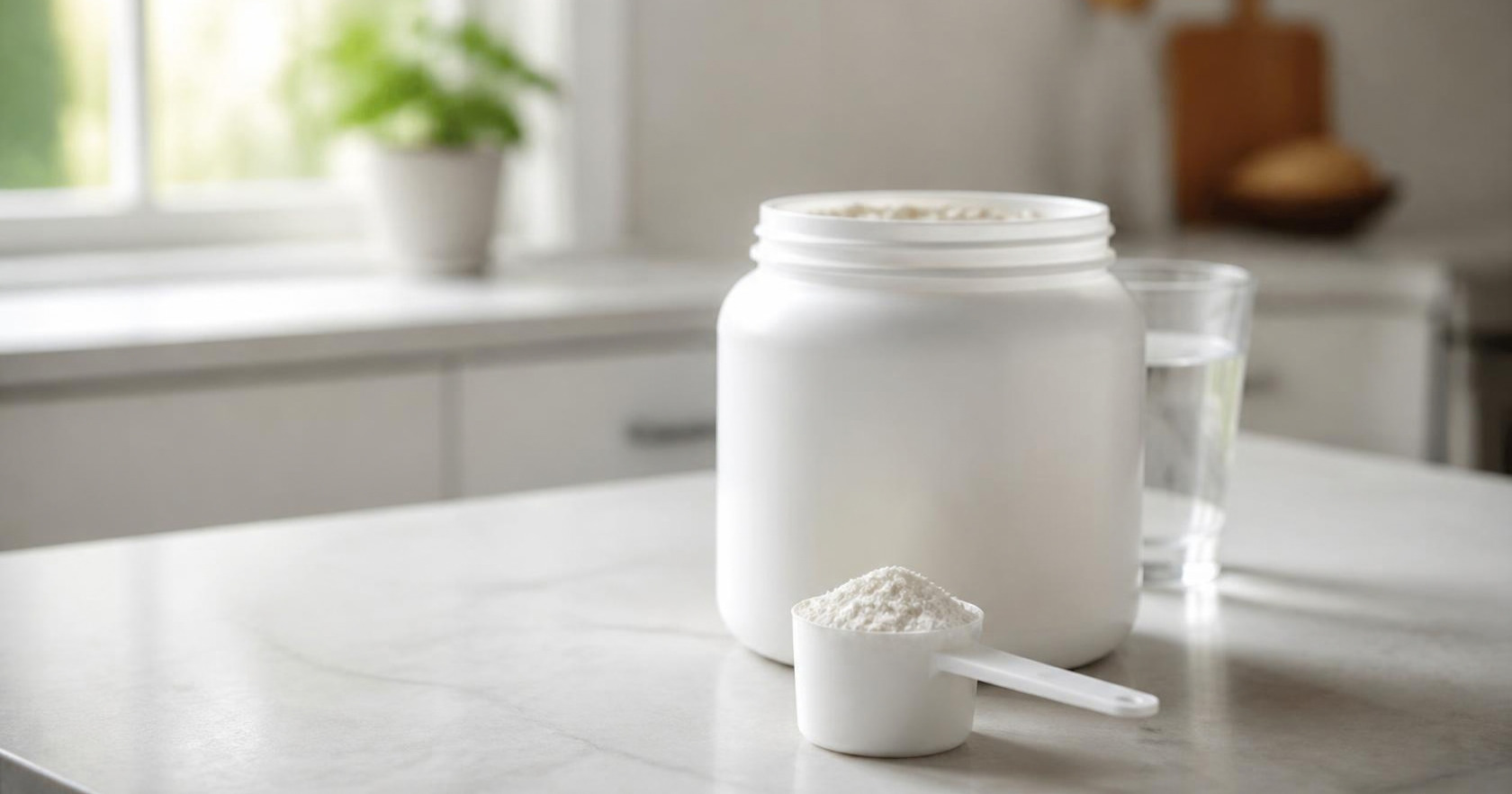
I took collagen for four years. I stopped a few months ago. And the reason it was not working had nothing to do with the brand, the dose, the type, or how long I had been taking it. It was my estrogen.
I want to be straight with you from the start. I am not a doctor. Everything here is research I have done myself and my own experience.
But I do want to show you what is really happening to the collagen in your skin after 40, what this stuff is actually made of, and the three questions I now ask before I spend a penny on a supplement.
The collagen loss is real, and it is not slow
I am not about to tell you collagen loss is a myth. It is not.
Your skin loses about 30% of its collagen in the first five years after menopause, then carries on dropping by around 2% a year after that. That research goes back to 1985 and has been confirmed since.
Now notice something. That loss tracks how long it has been since your menopause, not how old you are.
So when you look in the mirror and think this happened quite quickly, you are not imagining it. Dermatologists have a name for it. They call it the collagen cliff. And it is not only your face. It is your joints, and the tissue holding everything together.
The loss is real, which is exactly why the marketing works so well. You can feel it happening.
Why it happens, and why nobody asks
Here is the question I do not think anyone is really asking. Why then? Why those particular five years?
It is estrogen.
The cells that build and maintain collagen in your skin are called fibroblasts, and they have estrogen receptors sitting on them. Estrogen is the signal telling them to keep working. So when estrogen drops, two things happen at once. The building slows right down, and the breakdown speeds up.
That is the cliff. It is a hormonal event.
Sit with that for a second, because everything follows from it. You are not losing collagen because you are not eating enough collagen. You are losing it because you have lost the hormone that keeps it being made.
Think of a building site. The collagen powder is a delivery of bricks, and the bricks are fine. But estrogen is what keeps the bricklayers turning up. When the bricklayers have gone home, you can have as many bricks delivered as you like. Nothing is going up.
That is the bit nobody explained to me in four years of buying it.

What the studies actually show
I know what you are thinking, because I thought it too. There are studies. It says clinically proven on the tub.
There are studies. So I went and read what they found.
One big review pulled together 23 trials of nearly 1,500 women, and put together it looks good. Better hydration, better elasticity, fewer wrinkles. Then the researchers split the trials by who paid for them. The ones funded by supplement companies showed improvements across the board. The ones that were not showed nothing. Not a smaller effect. Nothing.
A second, bigger review of 35 trials did find real improvements in hydration and elasticity, but the wrinkle and skin density results came from a small handful of unusual studies. Take those out and the findings disappear.
Joints is the strongest part of the case, and I will be straight with you, the trials did find real relief. But there were only four, all rated high risk of bias, and the best recent one found that while pain improved, the actual space in the joint had not changed. So it might take the edge off the ache. It does not rebuild your knee.
Reading the studies themselves is what really got me. Undeclared authors with ties to the companies selling the ingredient. One stating it received no commercial funding, then mentioning further down that the manufacturer supplied the product and paid for the testing.
I am not going to tell you collagen has been proven not to work. That is not what the evidence says. What I will say is that in more than 25 years of research, nobody has run a proper, well designed, independently funded study showing it does what it is sold for. Take the manufacturer’s money out of the room and the effect disappears.
For me, that was enough.
What collagen powder is actually made from
This is the bit that properly stopped me, because I had never thought about where it comes from. I assumed something quite clean and quite clever.
It is hides, mostly cow skin, along with bones, hooves, tendons, ligaments, fish skin and fish scales. And these are not off cuts anybody was planning to eat.
Collagen and gelatin come from the same process and the same suppliers. The raw materials are described as waste products and byproducts of tanneries, slaughterhouses and butchers. The three biggest collagen manufacturers in the world all started out making gelatin.
I want to be fair, because the industry calls this upcycling and they have got a point. If an animal has been killed for me, using more of it beats throwing it away. I am not squeamish about that.
But here is what got me. This is leather industry waste, and we are paying a premium beauty price for it.
Is it worth the money?
At roughly $30 to $40 a tub, not for me. I did a high protein grocery haul in Aldi, and for that same money I bought enough protein to last five to seven days.
So you are paying a premium every month for a byproduct, to fix a problem that is hormonal, on the strength of studies the manufacturer paid for. When I put it to myself like that, I was kind of done.
If you want what is in the tub, the traditional version is bone broth. Same tissues, same amino acids, a fraction of the price, and you can see exactly what went into it. I am not going to promise you it will change your skin either, but at least it is real food.
Where I would put that money instead
I am not telling you to give up and accept it.
Estrogen has the best evidence for your skin. Women on hormone replacement therapy have measurably better collagen content, skin thickness and elasticity. Modest, but it shows up again and again. I am not a doctor and I am not telling you to take HRT. Personally I take it. If it is already something you are considering for your menopause symptoms or your bone health, it is worth knowing about the skin benefit too. That is a conversation for you and your doctor, not a decision to make in the supplement aisle.
Creatine is where I would put my money. It does nothing for skin elasticity, but it is one of the most researched supplements there is, and the research showing it works for muscle building includes studies not funded by the industry.
Protein and actual food matter more than either. Collagen is poor quality protein, missing amino acids you need and very low in leucine, the one that triggers muscle building. Compared head to head against whey in older women, whey worked and collagen did not. So if you are buying collagen and not hitting your protein target, you have that completely the wrong way round. Eat the meat, the fish, the eggs. That is where your collagen raw materials come from anyway.
The three questions I ask now
Who paid for the study? Not is there a study. Who paid for it. If every positive result has a manufacturer’s name attached, that is your answer.
Is this fixing my actual cause? My collagen was dropping because of hormones. I was treating it with protein. It was never going to work.
Does it still work without the work? If a supplement only helps when you are training and eating properly anyway, it is a multiplier. Treat it like one. Most supplements are like that.
My verdict after four years
I wasted hundreds. Am I telling you to throw yours away? No. If you are taking it, you feel better on it and you can afford it, carry on. I am not going to tell you what to do with your own money.
But I am not buying another tub. The evidence on skin was weak, the evidence on joints was weak, the stuff itself is leather industry waste, and the price is anything but weak. I would rather spend it on creatine, on protein, and on getting to the gym.
So go and look in your cupboard, and ask those three questions about every single thing in there. I think you will be surprised what does not survive.

Start with the food, not the tub
The food side of all this matters far more than anything you can buy in a tub. If that is the bit you are struggling with, I have put my meal plan together for you and it is completely free. There is nothing to pay.